



Most medical students who sit the UCAT have limited knowledge of what their UCAT score signifies, sometimes even after receiving it. It is important for students to understand how their score is ranked in the eyes of medical universities.
In this article, we will discuss what different UCAT scores mean, what they signify to various undergraduate medical schools, and how they can affect your entry into medicine. As the UCAT is used to guide judgement alongside academic qualifications, interviews and other extracurricular activities for medical entry.
The University Clinical Aptitude Test (UCAT) is a computer-based admissions test delivered through Pearson VUE centres across Australia and New Zealand. Introduced in 2019, it helps universities select Year 12 applicants for medical, dental, and some clinical science degrees based on their critical thinking, reasoning, and professional skills.
The UCAT Consortium schedules the testing window for undertaking the exam, each year between July - August.
How Do UCAT Scores Work?
If you are wholly invested in preparing and building strategies to gain the perfect UCAT score, it is crucial to also understand how the UCAT is scored.
The UCAT marks students based on the amount of correct answers that a student gets. In the UCAT test, there is no negative marking, therefore your performance on one question does not have a following impact on the other questions that you answer correctly.
While raw marks are based on the number of correct answers, UCAT scores are ultimately determined through a statistical scaling process. As a result, candidates can estimate their likely UCAT score from raw marks, but final scores cannot be predicted with complete accuracy as they may vary from year to year.
Let's draw on some important aspects on how are UCAT scores calculated. This can enhance your areas of focus and help you strategize to improve your chances of receiving a good UCAT score for future in medicine.
How Can I Calculate My UCAT Score?
The UCAT scores are calculated based on complex statistical processes.
There is no need to get anxious from the jargon, instead focus on how the UCAT scores can influence your choice of medical school.
The UCAT is split into four sections: Verbal reasoning (VR), Decision Making (DM), Quantitative Reasoning (QR), and Situational Judgement (SJT). Please note that that Abstract Reasoning has been removed from the 2025 UCAT.
Please note that if you are applying for 2027 admissions to medical school, it is important to note that many universities exclude the situational judgement test from their prerequisites.
The exclusion of the SJT This is due to the ongoing debate in Australia and New Zealand about whether the SJT is a good indicator of a future medical student's potential, as this section relies heavily on an understanding of medical ethics, which is not a part of the National Australian Curriculum.
How Are UCAT Scores Scaled?
The UCAT scores for VR, QR and DM are calculated between the range of 300-900 marks for a total mark that can range between 900 - 2700. For the VR and QR subtests, each question is worth one mark.
The Situational Judgement section is scored differently from the cognitive subsets. Instead of a numerical score, candidates receive a band score from Band 1 to Band 4, with Band 1 representing the highest level of performance. Situational Judgment Test (SJT) is not numerically scaled. Instead, candidates receive a band score from Band 1 to Band 4, which is reported separately and is not included in the total UCAT cognitive score.
In the Decision Making subtest, most questions are worth one mark, while multi-statement questions are worth two marks, with partial credit awarded for partially correct responses.
What Is A Good UCAT Test Score?
It is difficult to define what constitutes a ‘good UCAT score’ as results vary from year to year.
UCAT performance is best considered across the cognitive subtests rather than as a single fixed cut-off score. Generally, scores around 620–630 per cognitive subtest are regarded as competitive for entry into medicine, an average score of approximately 680 across the cognitive UCAT subtests, is considered a high UCAT score.
This average is calculated using Verbal Reasoning, Decision Making and Quantitative Reasoning, excluding the Situational Judgement Test.
This breakdown of UCAT scores can help you better understand how competitive your result may be when applying to medical schools.
Predicting UCAT Scores for 2026
The UCAT Consortium publishes average UCAT results each year and divides candidates into deciles, grouping students based on their performance relative to others who sit the test in the same year.
As the UCAT testing window runs between July and August, reviewing results from previous year can help you better understand how scores are distributed and how your performance may compare.
While previous-year results are not a precise indicator of future scores, they can be used as a general guide when planning your UCAT preparation. There is no fixed UCAT score required for entry, as score distributions vary each year.
From the 2025 statistics, Frasers students have been successful in achieving an average overall score of 2030. The public average for the UCAT 2025 was 1891 measured across 16,950 students this score is substantially lower than a Fraser’s student (7.35% lower to be exact).
Join our high-achieving students at Fraser’s UCAT Free Learning Academy and take the first step towards UCAT success today.

Is UCAT Compulsory For Every Medical University?
Students often ask, “When are UCAT scores sent to universities?”
Most universities use UCAT scores to rank applicants for a medical interview offer, and in some cases UCAT plays a primary role in shortlisting candidates. Some universities do not include the Situational Judgment Test (SJT) in their main ranking process, although it may still be considered separately.
UCAT is required for entry into most Australian medical and dental schools. While many universities do not publish a fixed UCAT cut-off score, applicants are still ranked competitively, meaning higher UCAT scores generally improve the likelihood of receiving an interview offer.
Sitting the UCAT itself is a prerequisite for consideration at UCAT-using universities.
Universities may adjust how UCAT scores are used from year to year.
What UCAT Score Is Needed For Medicine in Australia?
Percentages are indicative and subject to annual change.
Check out our Medical Interview Offer Calculator and get your predicted odds for a medical interview from universities!Medical Interview Offer Calculator and get your predicted odds for a medical interview from universities!
2025 UCAT Scores Percentiles Breakdown
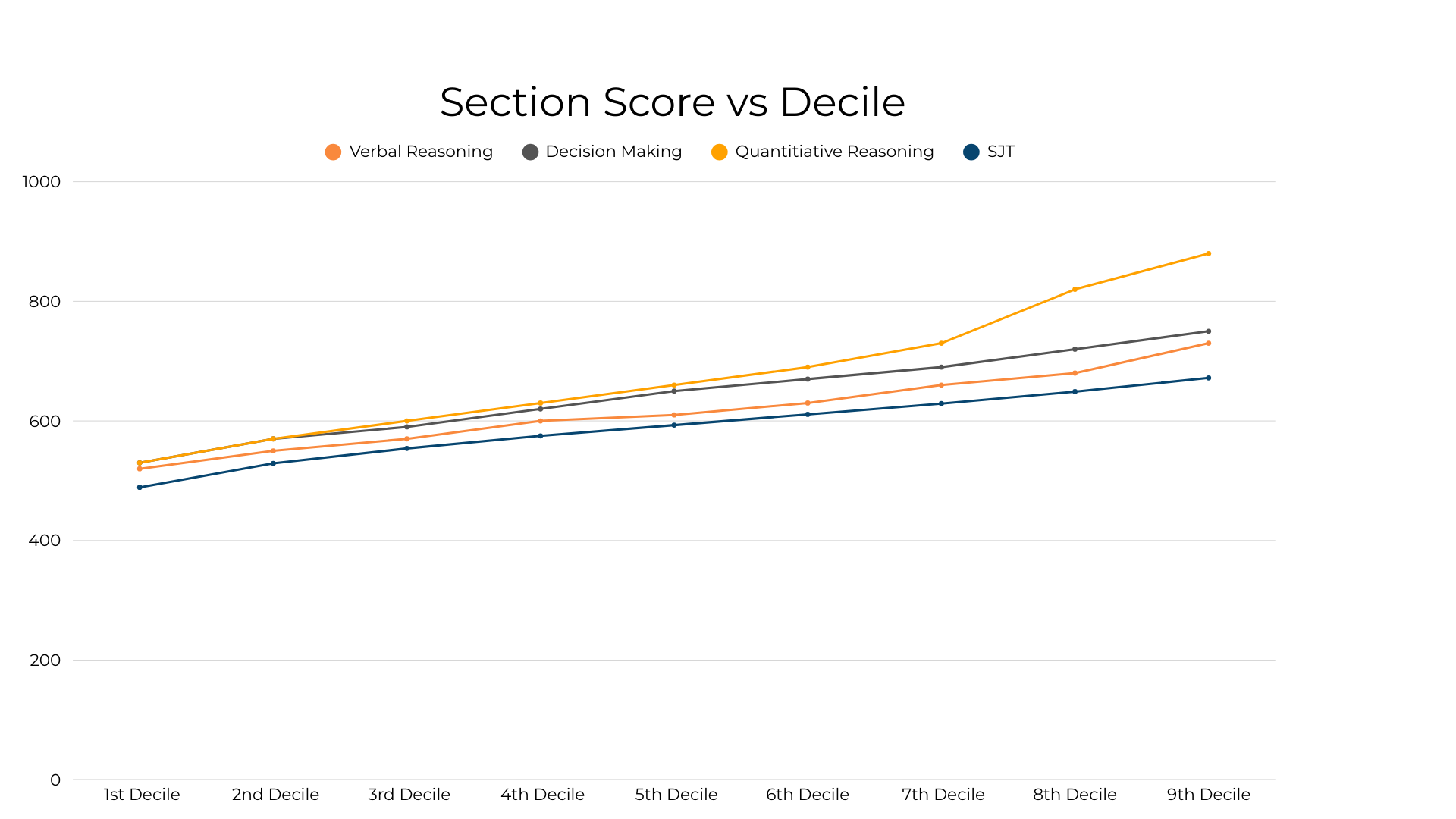
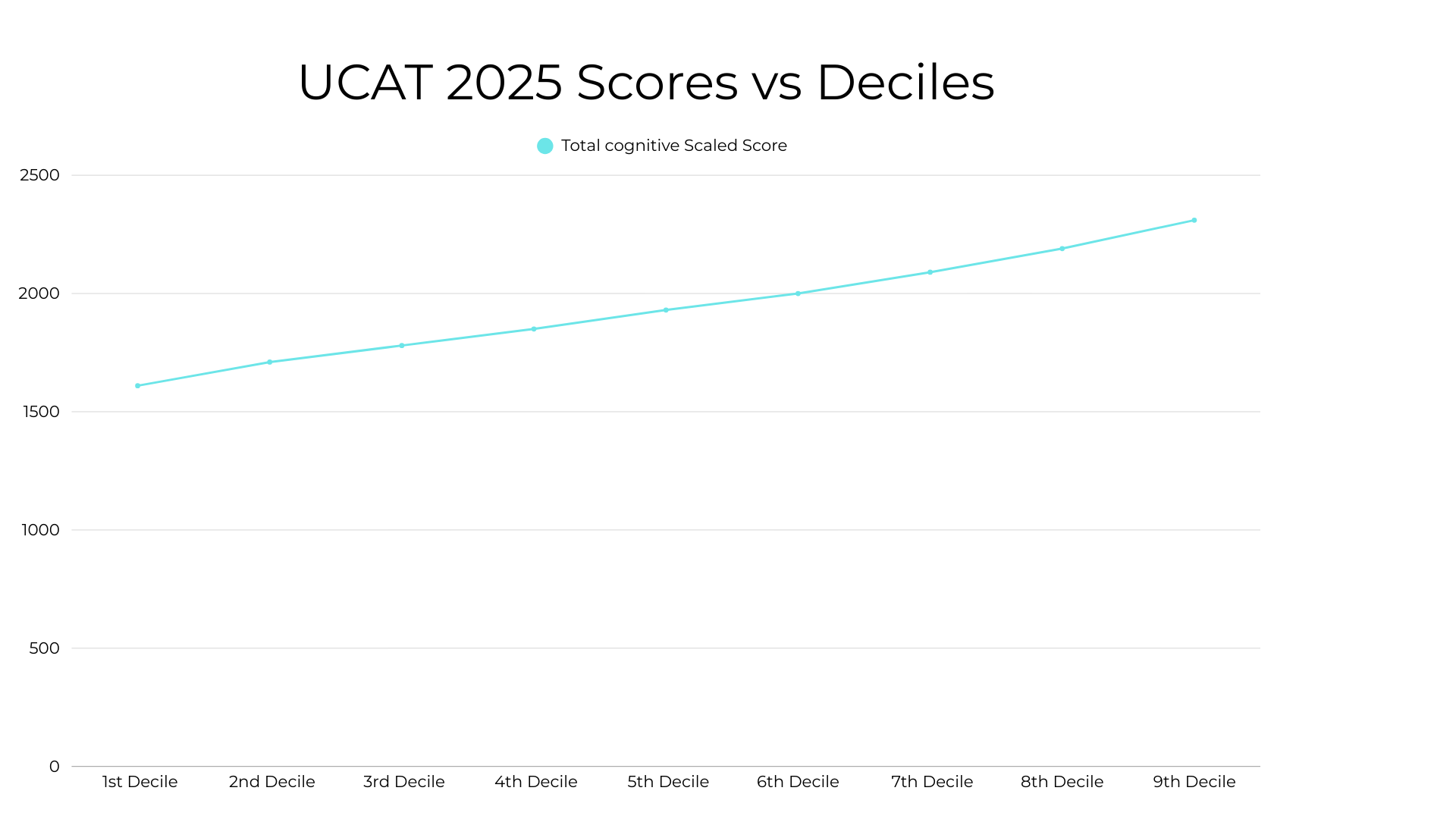
UCAT scores are grouped into deciles, meaning each group represents 10% of the applicants that took the test in the same year. A total scaled score is generated by summing up individual scores of Verbal Reasoning, Decision Making and Quantitative Reasoning.
Here’s an example
James scored 2060 on the UCAT, placing him around the 81st percentile, meaning he did better than 81% of candidates and sits in the top decile (top 10%). Deciles split results into 10 groups, from highest scorers to lowest.
Molly scored 1350, placing her in about the 3rd percentile, meaning she performed better than only 3% of test-takers and falls in one of the lowest deciles.
The graph below shows how section scores from 2025 UCAT students compare across each decile.
If your still uncertain about deciles and what this means for your UCAT test, feel free to book a consult so we can answer any questions you have!
What Should I Do With My UCAT Score?
Once you complete the UCAT exam, you will receive instructions on how to access your UCAT Score Report through Pearson VUE.
Your results will be made available within 24 hours of sitting the exam and can be viewed online, printed, or saved as a PDF.
The UCAT Consortium automatically shares your results with universities you apply to, so you do not need to submit your UCAT score separately unless you are applying to a non-consortium institution.
Universities outside the UCAT Consortium will not have access to your UCAT score. UCAT scores are valid for one admissions cycle only, meaning that if you sit the UCAT in 2026, your results can be used for 2027 medical school entry.
What To Do Next?
If you need guidance on preparing for your UCAT, enrol in one of our UCAT courses, and learn from our expert tutors.
Make sure you explore our other UCAT articles to support your preparation and maximise your performance.
Best of luck with your UCAT journey! Be sure to check out our other articles below.
- A Roadmap To UCAT Study
- How To Improve Timing In Your UCAT Preparation
- Why UCAT Practice Doesn’t Necessarily Make You Perfect
- UCAT Prep Timeline: How long do I need to prepare for UCAT?
- How to Balance High School Study with UCAT Preparation
- Best Ways to Revise for UCAT: 5 Top Tips
.png)


.png)